Who can we trust? Media use and trust in sources.
More than half of respondents to my questionnaire expressed distrust in political media, both legacy and online. But, If we distrust our sources and keep using them, is that a merely a healthy scepticism of media or the sign of a deeper crisis of confidence?
In a previous article I discussed political engagement among respondents to a questionnaire about politics and the media. In that piece, the figures suggested that although many respondents both understood the UK voting system and voted, 60% reported feeling unheard locally and 75% nationally. What, I wondered, was driving these feelings of discontent?
Turning again to my questionnaire, I looked at the data related to media consumption, both frequency and types, to see if I could find any answers. Figure 1 shows the results of questions about media consumption. The questions were 'How often do you engage with political content from traditional sources (Radio, TV, Newspaper)?', and 'How often do you engage with political content online?' Answers: Daily, weekly, occasionally, and rarely. The percentages shown in the following graph are of respondents who gave 'Daily' or 'Weekly' as their response.
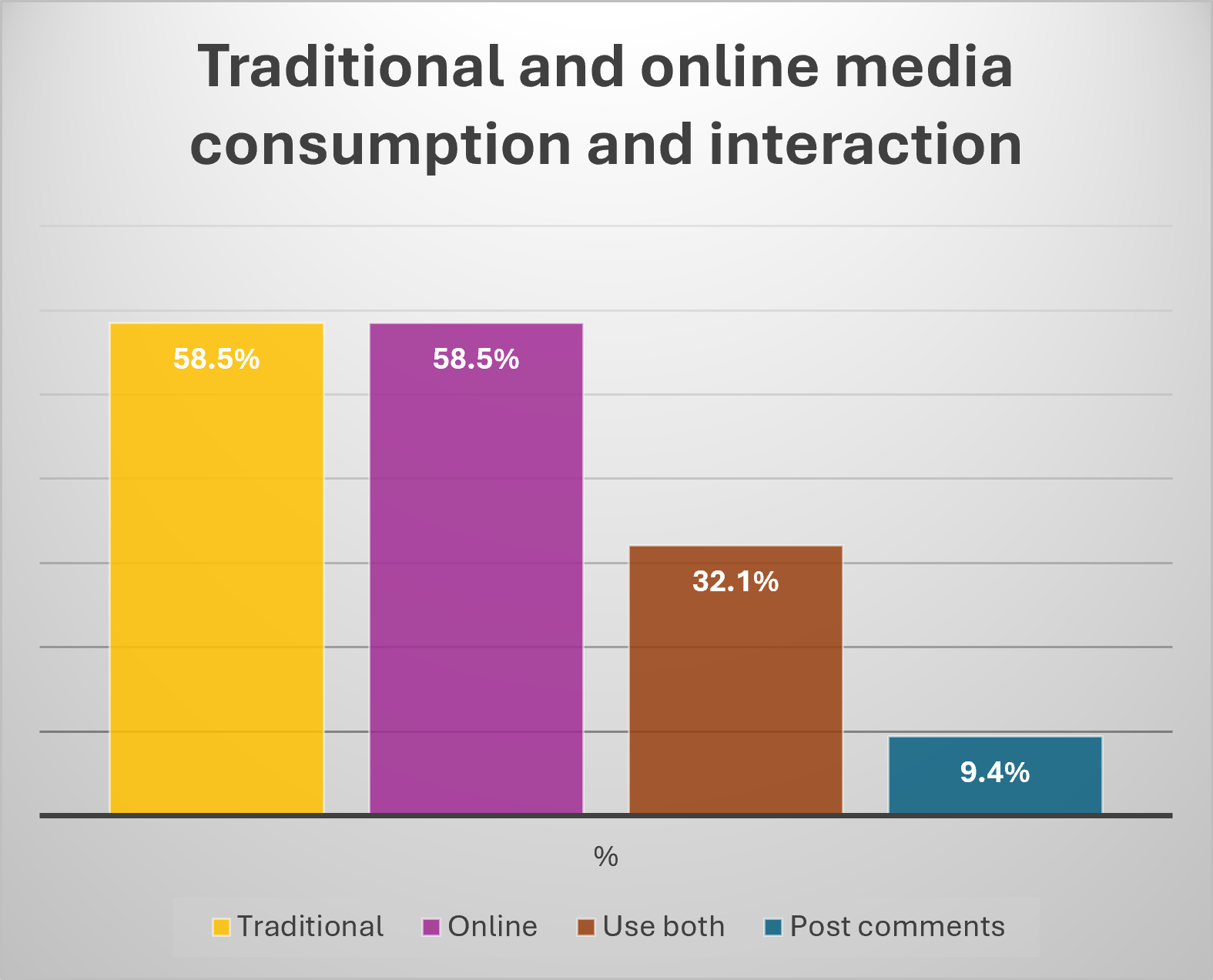
31 of my 53 respondents stated that they consumed political output from legacy media with this frequency and the same for social media with 17 stating they used both. But of the social media consumers only 5 respondents said they posted replies, comments, or responses to online content daily or weekly. This suggests a somewhat passive consumption of political media both traditional and online, which is in line with the previous article's conclusion that far more respondents voted (67.9%) than had contacted a politician or party directly (34%). However, although respondents are consumers of political media both legacy and online, do they trust their sources?
In response to the questions do you trust the media sources you use? Both traditional and online sources do quite badly. The question had a Likert scale answer from 1 'absolutely not' to 5 'absolutely do'.
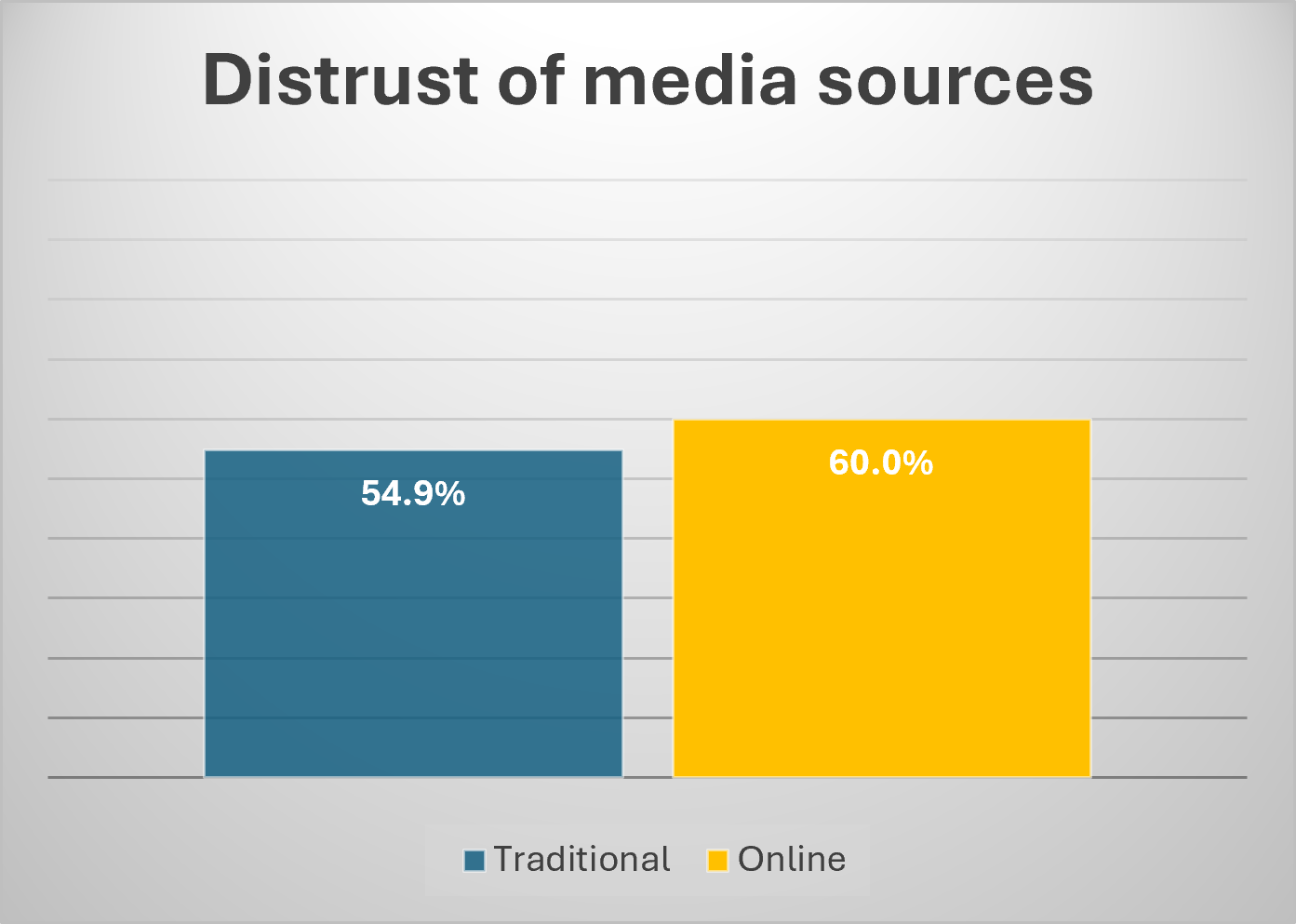
This chart shows 54.9% of respondents distrusted traditional media political output, a figure that rose to 60.0% for online media. This suggests that many people have little faith in either traditional or online political content. The concerns about trust in online sources raised in my survey are also expressed in the Reuters Digital News Report which identifies trust and misinformation as significant issues for news consumers.
These figures present a conundrum. While more than half of respondents regularly consume political media, only around a quarter expressed trust in either form. 25.5% gave a score of 4 or 5 for traditional media, compared with 20% for online sources. Around one in five selected the midpoint of the scale, suggesting neither trust nor distrust. That traditional media was trusted slightly more than online media in my survey is perhaps not surprising in a country with many well-established news providers. However, people do have the choice of what media to consume, and in my conversations outside the questionnaire itself I found several people who stated that they trusted their sources explicitly because they chose them. This raises another interesting question. Does the ability to choose one's own sources lead to a better-informed public, or does it simply allow people to reinforce existing beliefs?
So, my respondents consume political media regularly, distrust much of it, and believe social media increases political tensions (over 92% gave this response and 83% suggesting that it was by a lot), and yet they continue to rely upon it as a source of political information. Whether their views reflect healthy scepticism or a deeper crisis of confidence in media output remains to be established, alas my data cannot answer that.