
Are they listening? Political participation and feeling heard.
A questionnaire undertaken in central London reveals most people vote, most people understand the system, and yet three-quarters feel unheard by it. Is this just sour grapes, or something more fundamental?
In the spirit of true journalistic investigation, I decided to take to the streets and conduct a survey. I went seeking answers to questions about people's feelings on the business of politics and the political arena and their relationship to contemporary media output.
The survey explored people's understanding of the UK voting system, whether they voted, and how, in the most rudimentary sense, they felt about it. It also examined respondents' perceptions of different forms of media and the extent to which they trusted them. I will be the first to admit that my sample size is not huge, and also that my locations for collecting responses could be construed to have a distorting influence on the results. However, over the course of three days I approached 275 people in and around central London, 219 people declined to take part and of the 56 responses received, 53 were valid.
In the first section of the survey I examined respondents' engagement with the political system and posed, among others, the following questions: 'Do you feel you understand how the UK political voting system works?', 'Did you vote in the last UK local or general election?', and, 'Have you ever contacted a politician or political party about an issue directly?' The results are shown in the following chart. The graph below presents an aggregation of answers: 'Yes', and 'Mostly' to understanding how the UK voting system works.
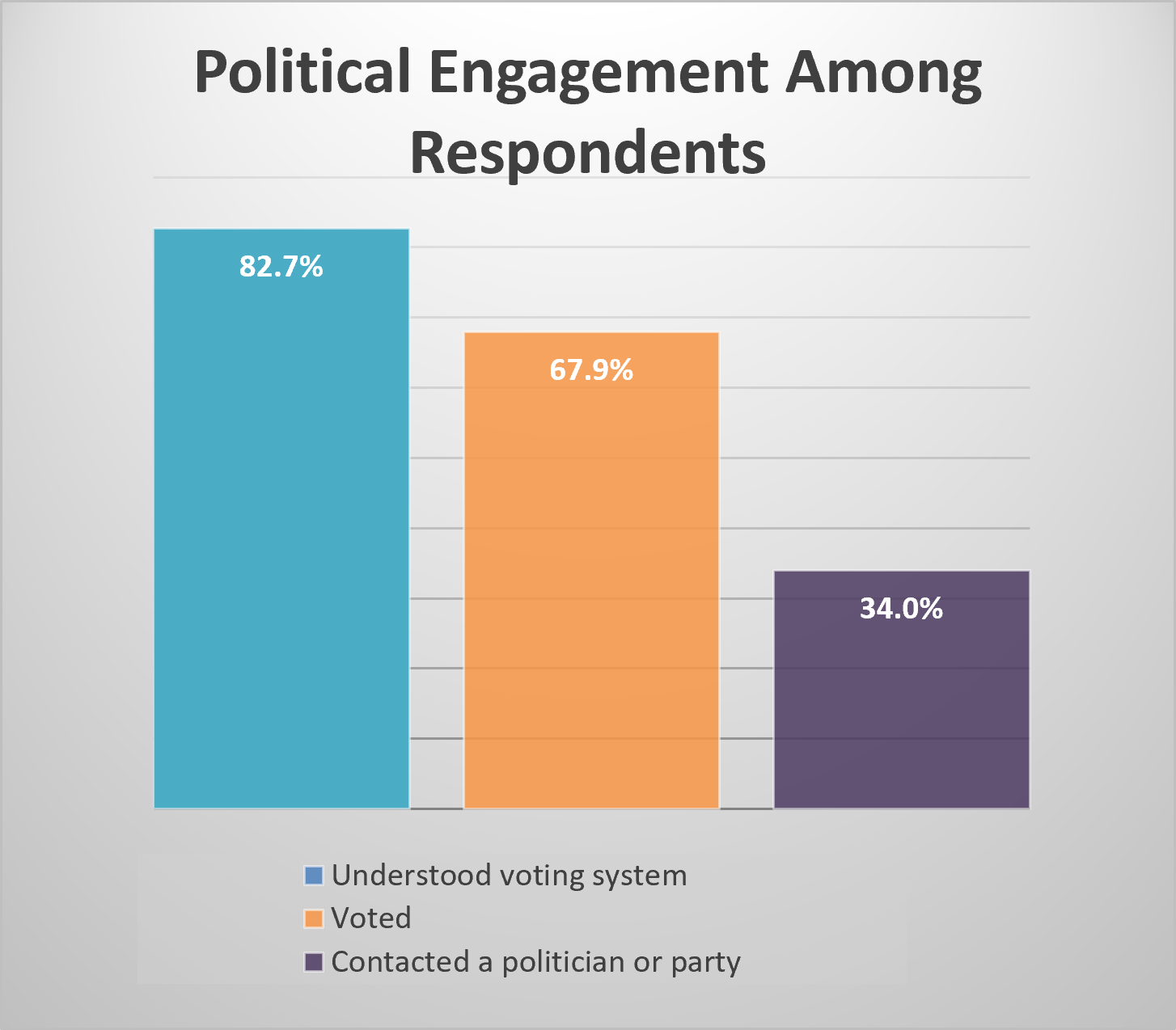
While the responses suggest that people are generally engaged with politics, the level of direct contact with politicians or political parties is significantly lower than those who turn out to vote. However, whether this public engagement brings with it a feeling of being heard by political institutions is a more interesting question.
This was addressed by the questions, 'Do you feel the current political system works for you?', 'Do you feel "heard" as a voter locally?', and 'Do you feel "heard" as a voter nationally?'. These three questions all had a five-point Likert scale response from 1 'absolutely not' to 5 'absolutely do'. The percentages shown in the following graph are the totals of all respondents who gave a response of 1 or 2 to the questions, that being a less than neutral position on the matter.
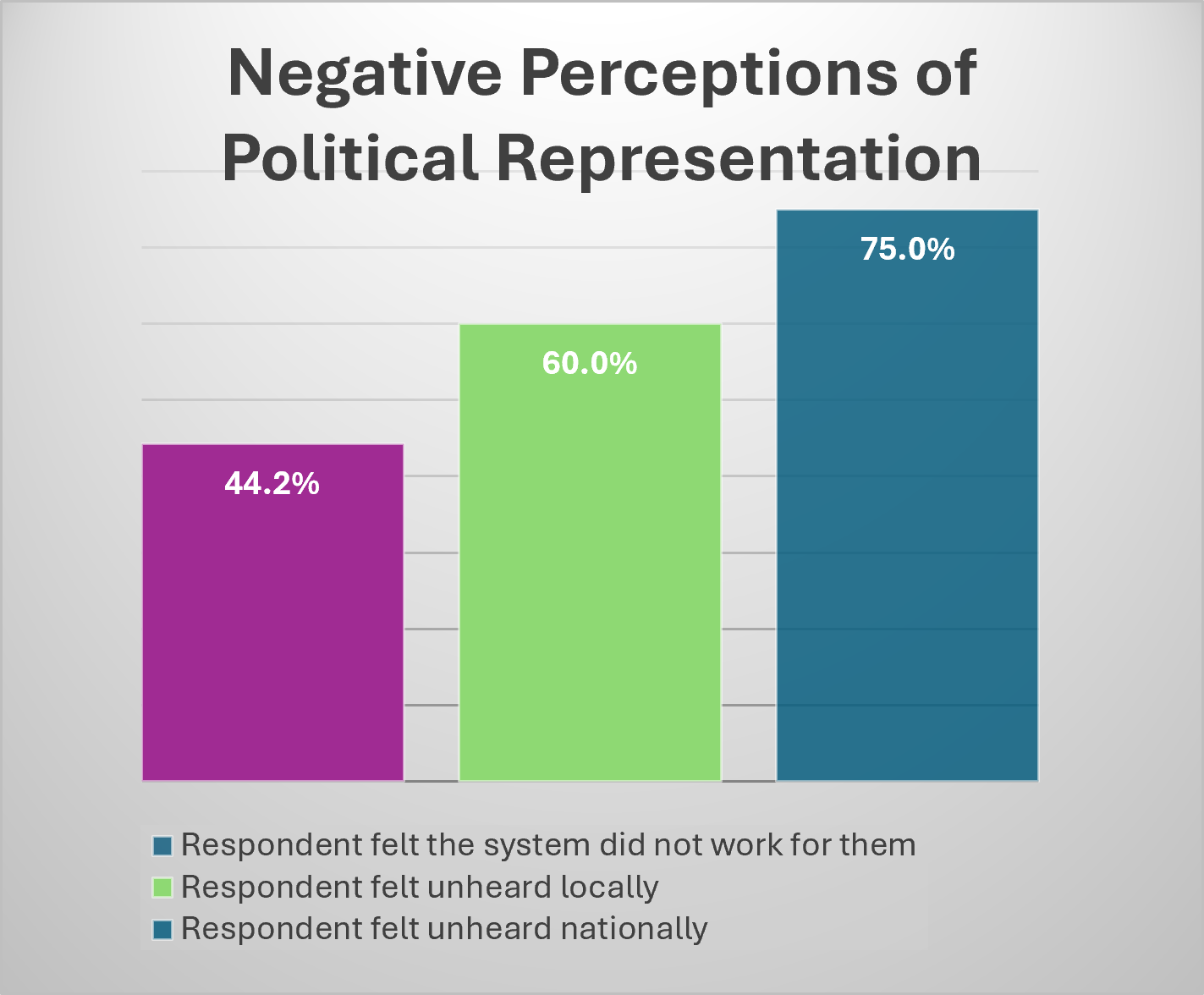
So, what can we understand from these findings? They seem to suggest that dissatisfaction with the political arena cannot be explained by a lack of engagement, perhaps the opposite. Most respondents stated that they understood the political system and, within my sample, 67.9% claimed to have voted in the last local or general election. Yet despite this participation, 75% reported feeling dissatisfied at a national level and 44.2% stated that the system did not work for them. However, only a third of respondents, 34%, indicated they had personally contacted a politician or political party directly.
In a voting population of 46,560,452 for parliamentary elections recorded by the Office for National Statistics as of 2021, there are inevitably going to be a great many disappointed voters, people who just did not get what they wanted. Therefore, might this just be a case of sour grapes? Is it reasonable to feel let down by the political system because it fails to deliver the result you personally wanted, or does the level of dissatisfaction shown here reveal something more fundamental about the relationship between people in the street and those who govern them?
What do you think? Do you feel your voice is heard by your politicians locally or nationally? Take our poll and let us know.